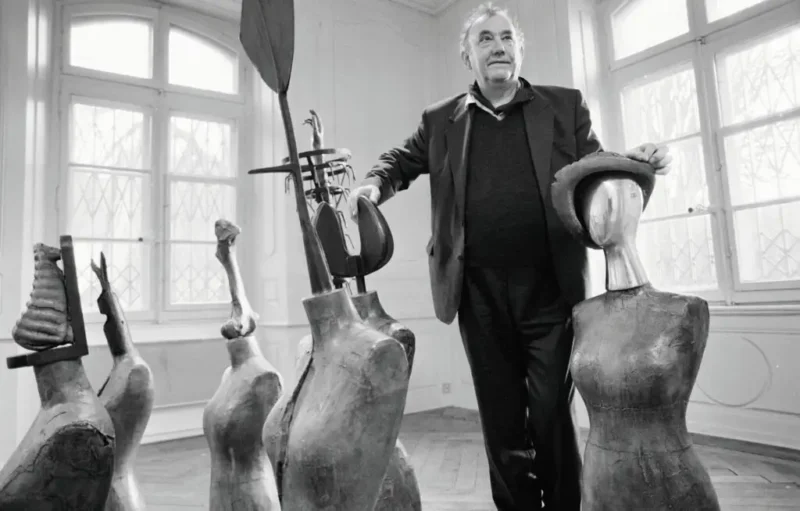
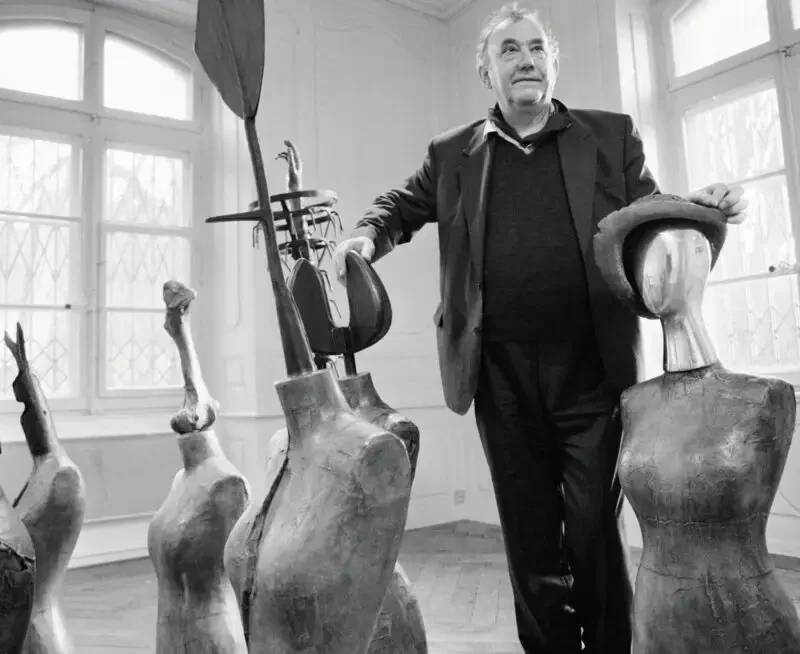
DANIEL SPOERRI, 1930-2024
Daniel Spoerri, born Daniel Isaac Feinstein, was one of the most original figures in post-war European art. A Romanian-born Swiss artist, he is best known for transforming everyday objects into works of art, becoming a leading exponent of the Nouveau Réalisme movement and the creator of Eat Art.
In 1942, following the murder of his father during the anti-Jewish persecutions in Romania, he fled with his family to Switzerland, where he adopted his mother’s surname, Spoerri. In Zurich he trained as a dancer and, after further studies in Paris, became principal dancer at the Bern Opera. During the same period, he also worked as a theatre director, concrete poet and avant-garde publisher, experiences that shaped his interdisciplinary approach to artistic practice.
After moving to Paris in 1959, Spoerri created his first celebrated tableaux-pièges (“snare-pictures”), works made by fixing plates, cutlery and everyday objects exactly as they had been left after a meal or a particular event, before mounting them vertically as wall pieces. These assemblages, which transformed fragments of ordinary life into lasting records of a specific moment in time, quickly established his international reputation and led to his participation, in 1960, in the founding of the Nouveau Réalisme movement alongside artists such as Yves Klein, Arman, Jean Tinguely and Niki de Saint Phalle.
From the late 1960s onwards, he expanded his artistic research through Eat Art, a project exploring the relationship between art, food and conviviality by means of restaurants, galleries, performances and publications. Throughout his career he also produced sculptures, assemblages and installations, consistently investigating themes of chance, memory and the transformation of everyday objects.
In 1989, Spoerri founded the Daniel Spoerri Garden in Seggiano, Tuscany, an open-air sculpture park featuring works by himself and numerous contemporary artists. Conceived as an evolving museum in the landscape, it reflects his lifelong belief that art should remain closely connected to everyday experience. His innovative practice, which blurred the boundaries between art and life, secured his place as one of the most influential figures in twentieth-century object-based art.
For further information, please visit the artist’s official website