Room 14
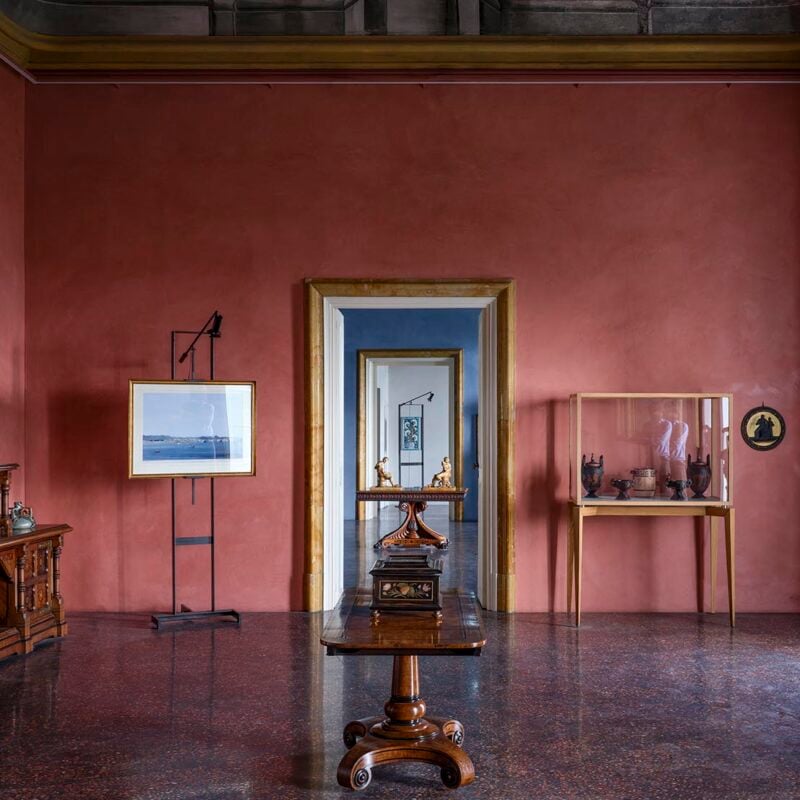
For the colours of the State Rooms were chosen Marmorino, a technique that mixes colour into the plaster, before it is applied to the wall. Embedding the colour in this way gives a deep, richly chromatic surface that changes according to the light.
In the display case
In the display case we have placed objects that each take their inspiration from the ancient world between the end of the 18th and the beginning of the 19th centuries. On the sides, the Wedgwood vases (c. 1780) are faithful reproductions of the original Attic vases found in Pompeii and Herculaneum. These became famous because they once belonged to Sir William Hamilton, British Ambassador to the Kingdom of the Two Sicilies at the time of the Bourbons. The two basalt urns (1805) on the first row are signed by William Bullock, George’s brother: he is much looser in his decorative motifs than Wedgwood. The wine cooler, produced by Davenport (c.1815) takes its inspiration from Ancient Egypt and the Ancient Greece.

Gilbert & George
The disturbing presence of Gilbert & George’sn Depression (1980) is a sombre meditation on the fears of contemporary man.
Tetsumi Kudo
On the right hand-side of the mantelpiece, the decomposed portrait of Tetsumi Kudo.
Tom Phillips
In this room, you will also see the first of five Treated skulls (1996) by Tom Phillips. Using a variety of materials including collages made from the calling cards of prostitutes or the hair from his beard, he began adapting the Western Memento Mori traditions, mixing in influences from other cultures.