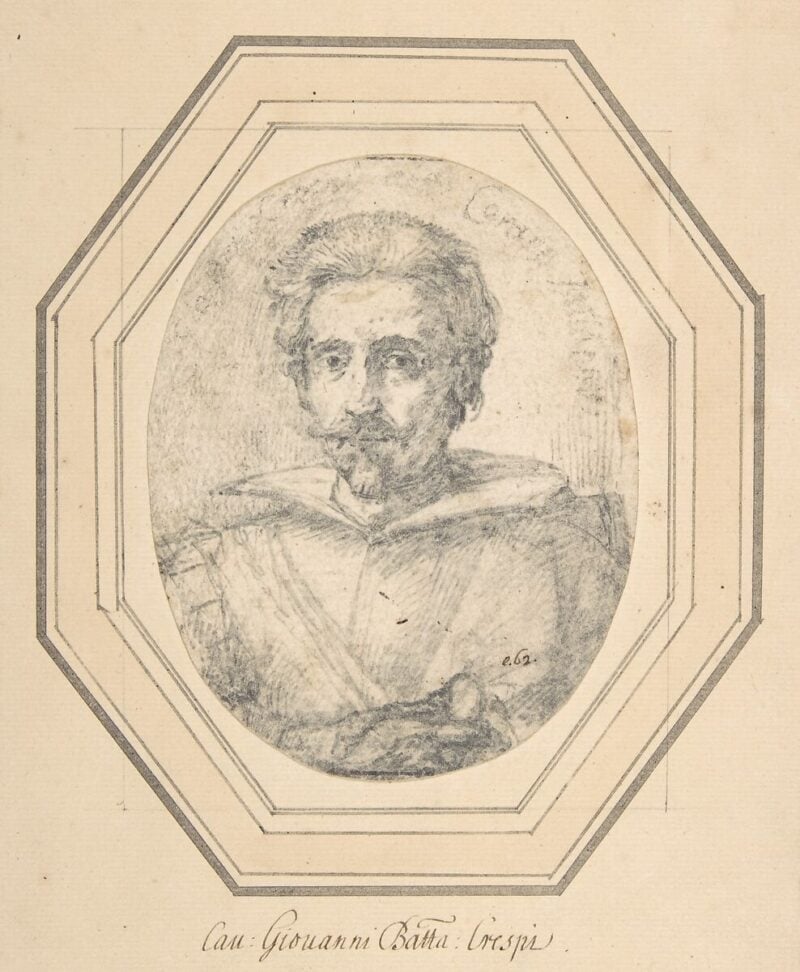
GIOVANNI BATTISTA CRESPI, 1573-1632
Giovanni Battista Crespi, known as Il Cerano, was born in Romagnano Sesia in 1573. He trained under Prospero Fontana, a Bolognese Mannerist painter from whom he learned solid technical and compositional methods.
At a very young age he moved with his family to Cerano, a town near Milan, from which is derived his well-known nickname. Milan was soon his main centre of artistic activity and where he spent most of his career, creating many of his most important works.
Deeply influenced by Caravaggio’s naturalism, Cerano nevertheless developed his own uniquely recognizable style. His works are distinguished by their intense drama, theatrical use of light and shadow, strong facial expressions and a colour palette capable of accentuating the pathos of sacred scenes. Emotional and spiritual tension becomes one of the central components of his painting.
Among his most famous masterpieces are ’ St. Francis in Adoration of the Crucifix’ and ‘Christ crucified with the Virgin, St. John and the Angels’. These works testify to his ability to blend realism and spirituality in images of great visual and devotional impact.
His excellent reputation earned him the esteem of Cardinal Federico Borromeo, who in 1621 appointed him director of the Academia Ambrosiana. This had been founded to counter the Mannerist movement’s negative moral and qualitative impact on sacred painting.
Giovanni Battista Crespi died in Milan in the summer of 1632. Today he is considered one of the leading figures of the Lombard School of painting between the 16th and 17th centuries. He is a key figure in the transition to a more intense, realistic and emotionally engaging style of painting.