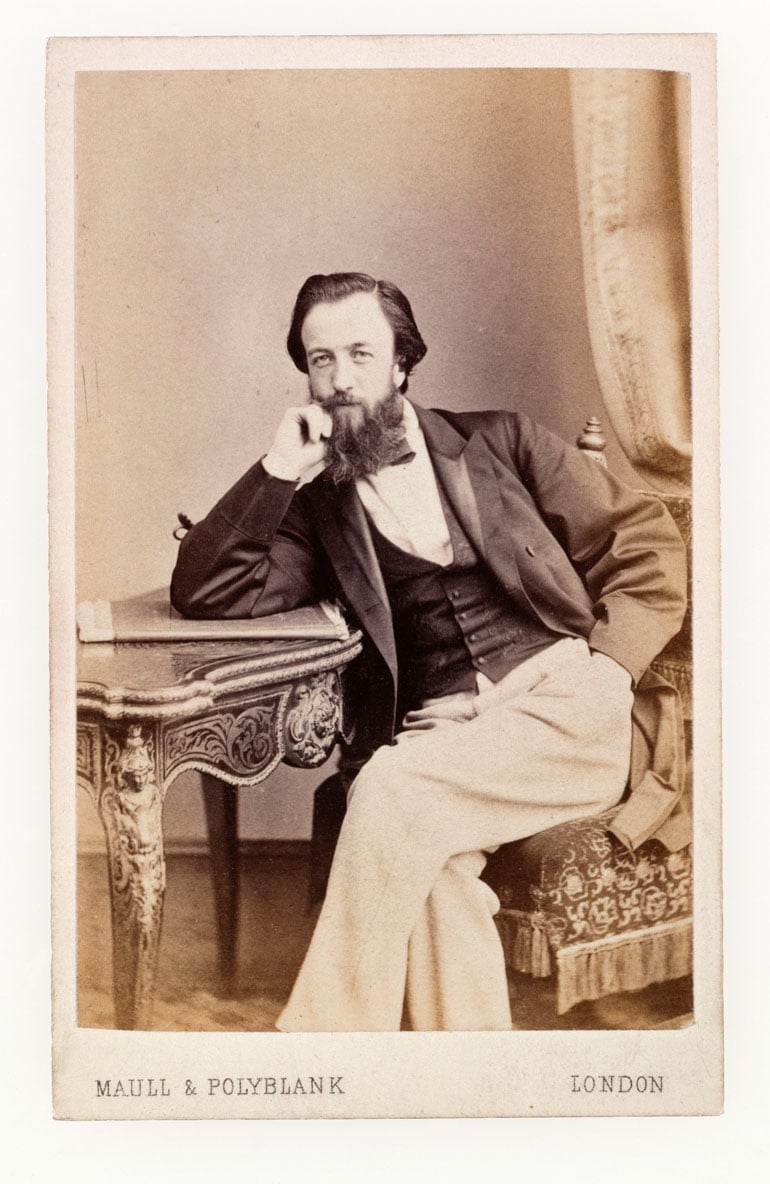
CHRISTOPHER DRESSER, 1834-1904
Born in Glasow in 1834 to a middle class family, Christopher Dresser studied botany and had a deep love of art, even as a child. He demonstrated such exceptional talent that he was admitted, two years early, to a Government Schools of Design; he managed to perfectly combine his scientific knowledge with his passion for art: by studying the anatomy, adaptability and symmetry of plants, he developed a design standard that would lead him to create a plate for the book ‘The Grammar of Ornament’ by Owen Jones (1856).
In 1862 he published ‘The Art of Decorative Design and Development of Ornamental Art’ for the International Exhibition, this was republished for the London International Exhibition.
Following his mentor Owen Jones and his passion for Oriental art, Dresser invented a modern decorative style: he claimed that decoration was the highest of the arts because it was purely mental in origin.
In 1876 he travelled to Japan on what would turn out to be the most important voyage of his life, and it was here that he studied Japanese art in depth.
On his return to England, his work underwent a profound change and he devoted himself to a series of silver and silver plate pieces stripped of ornamentation and simplified in shape. He marked these with “Dr Dresser’s Design” and thus became the first designer to sign his work.
In 1880 he opened The Art Furnishers Alliance for lovers of avant-garde decorative supplying a full range of furniture. The Alliance was not successful because the items offered “clashed” with the homes and furnishings of the time and, after only 3 years, it filed for bankruptcy. Thereafter Dresser’s fortunes waned, he moved to a village far from London, financial problems mounted and he realized that fashions were changing – the Arts and Crafts movement took hold with William Morris as its leading light. His fame was such that he was mistakenly considered as the sole architect of England’s 19th century design revolution for many decades after.