CHARLES ROBERT ASHBEE, 1863-1943
Charles Robert Ashbee was born in 1863 in Isleworth, Middlesex, England.
In 1883, he went up to King’s College, Cambridge, to study history. During his university years he developed a strong interest in art and design.
After graduating in 1886 he abandoned his academic career and chose instead to devote himself to art and design. In 1888, he founded his own design company, the “Guild of Handicraft”, in London. The main goal of the Guild was to securely connect traditional craftsmanship and handiwork together with design and artistic experimentation. Ashbee became a leading figure in the Arts and Crafts movement, providing through his work, a concrete challenge to the narrow aesthetic created by mindless mass production and industrialization. Under his leadership, the Guild of Handicraft became an important centre for the production of furniture, silver, jewellery, ceramics and textiles.
In 1902, Ashbee moved the Guild of Handicraft to Chipping Campden, Gloucestershire, and purchased a number of medieval buildings to house his artistic community. Here, he continued to promote his ideas through the training of a new generation of artists, designers and artisans.
In addition to object design, he also dedicated himself to architecture. He designed several houses and buildings, often incorporating elements of traditional English architecture and using local materials.
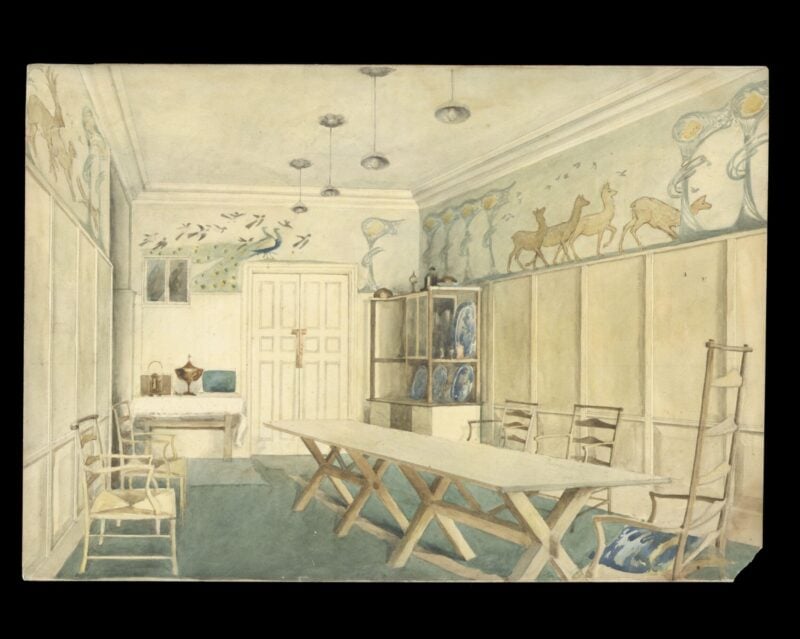
The watercolour opposite (© Victoria and Albert Museum, London), by his friend Fleetwood C. Varley, is of Ashbee’s dining room in his house in Cheyne Walk. The Thames is still visible from this Chelsea street as the Embankment was yet to be built.