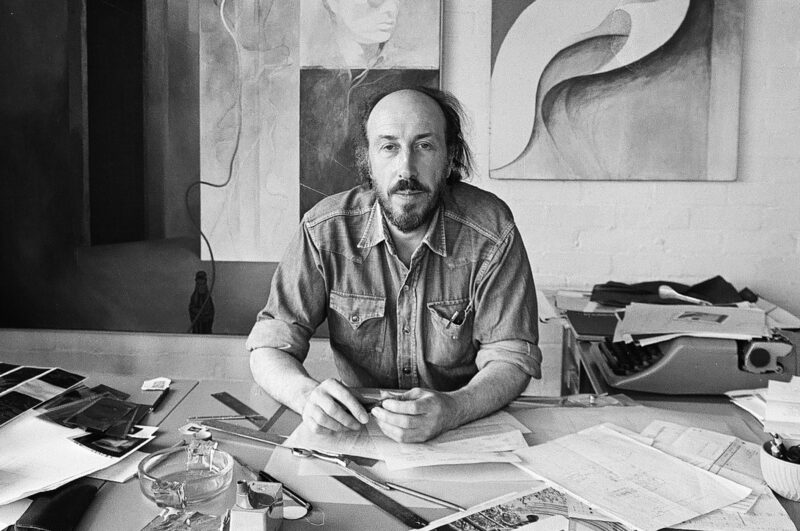

RICHARD HAMILTON, 1922-2011
Richard Hamilton was one of the most influential British artists of the second half of the twentieth century and one of the ‘fathers’ of Pop Art. Painter, collagist, graphic designer and theorist, Hamilton critically investigated the relationship between art, mass media, technology and consumer culture.
Trained at the Royal Academy Schools and later at the Slade School of Fine Art, Hamilton’s approach was immediately experimental and analytical and focused on contemporary visual and communication languages. In the 1950s he came into contact with the Independent Group, a London based intellectual movement that explored popular culture, industrial design, advertising and cinema – elements that became central to Hamilton’s research.
In 1956 he created the iconic collage Just what is it that makes today’s homes so different, so appealing?. Composed of images taken from magazines, adverts and mass media, the work offers an ironic and penetrating vision of consumer society and contemporary domestic ideation. Precisely because of these characteristics, this collage is considered by numerous historians and critics to be the first work of Pop Art, anticipating themes and strategies that will become central to the movement.
His work does not limit itself to celebrating popular culture, but analyses its mechanisms, contradictions, and political and social implications. He worked out an intense theoretical and didactic theory that contributed conclusively to the conceptual definition of European Pop Art.
Richard Hamilton had a decisive influence on contemporary art, and is considered one of the most lucid and important figures of twentieth-century visual culture.