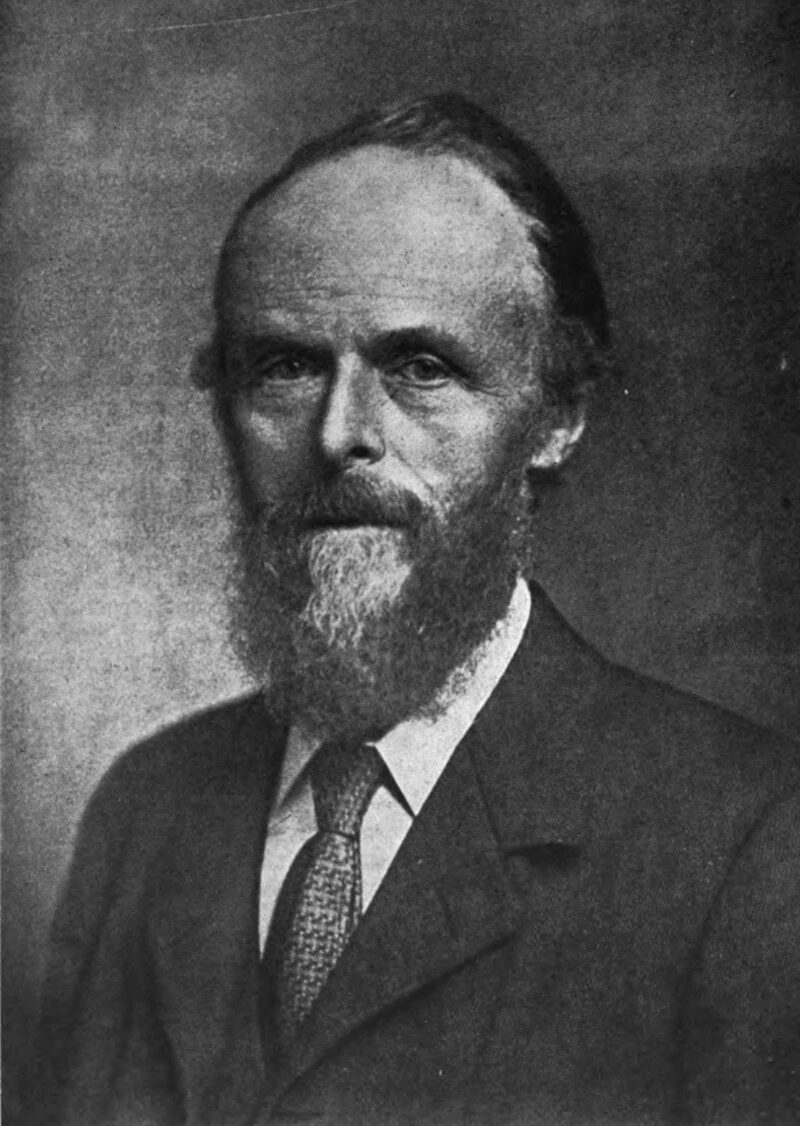
WILLIAM DE MORGAN, 1839-1917
William De Morgan was an English ceramist, designer and writer. As one of the leading figures in the Arts & Crafts movement, he is known for having profoundly revived the art of British ceramics between the 19th and 20th centuries.
Son of the mathematician Augustus De Morgan, William trained as a painter, but soon started to explore the decorative arts, where he came across William Morris and his milieu. He was of the same mind both in terms of aesthetics and social ideals. Convinced that art had to rediscover the value of outstanding artisanal craftsmanship, De Morgan dedicated himself to studying historical techniques and in particular those of Islamic and Renaissance majolica.
Starting in the 1870s, he began an independent manufacture of tiles, panels and vases, distinguishing himself in the use of refined glazes and intense colours inspired by natural and mythical motifs: animals, mythological figures and idealised flora. His contribution to the rediscovery of metallic glazes, reinterpreted with great originality and technical rigor, is well known.
De Morgan’s oeuvre fits perfectly withing the Arts & Crafts ideal, a combination of beauty, functionality and craftsmanship. His ceramics are used in architecture and interiors, often in dialogue with other Arts & Crafts practitoners, contributing to the construction of a single, sophisticated decorative language.
In his later years, De Morgan gradually gave up producing ceramics and devoted himself to writing, achieving considerable success as a novelist. Upon his death in 1917, he nonetheless left a vital legacy to the history of decorative arts; ceramics had become their own art form, combining tradition, invention and technical quality, and went on to deeply influence twentieth-century design.