GIANFRANCO BARUCHELLO, 1924-2023
Gianfranco Baruchello was one of the most singular and independent individuals in Italian contemporary art – artist, writer, theorist and tireless experimenter. His approach is deliberately at angles to the canonical movements of the second half of the twentieth century. He developed a unique language of accumulation, fragmentation and unfettered correlations.
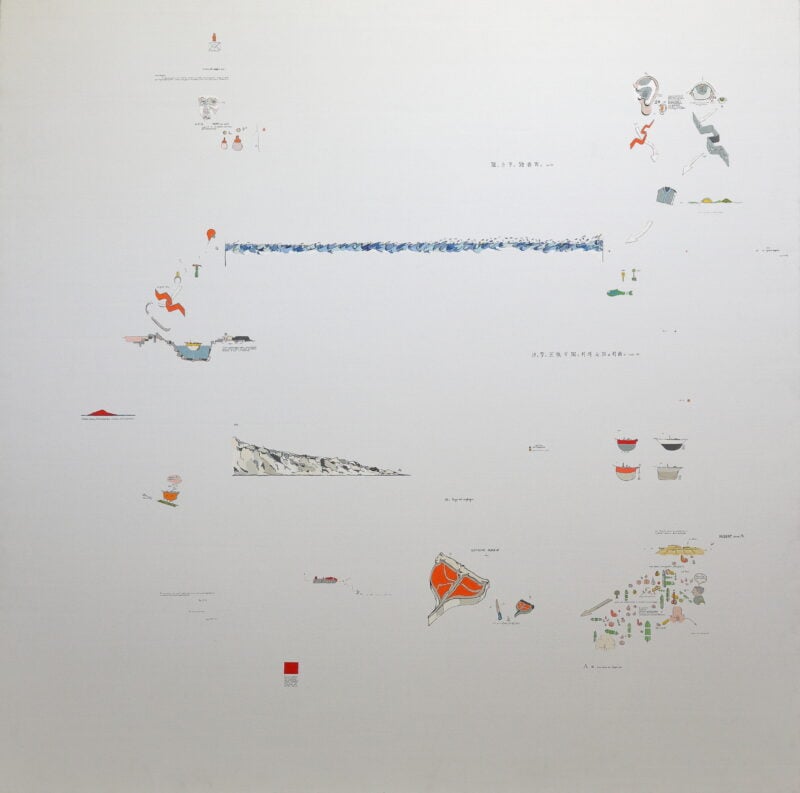
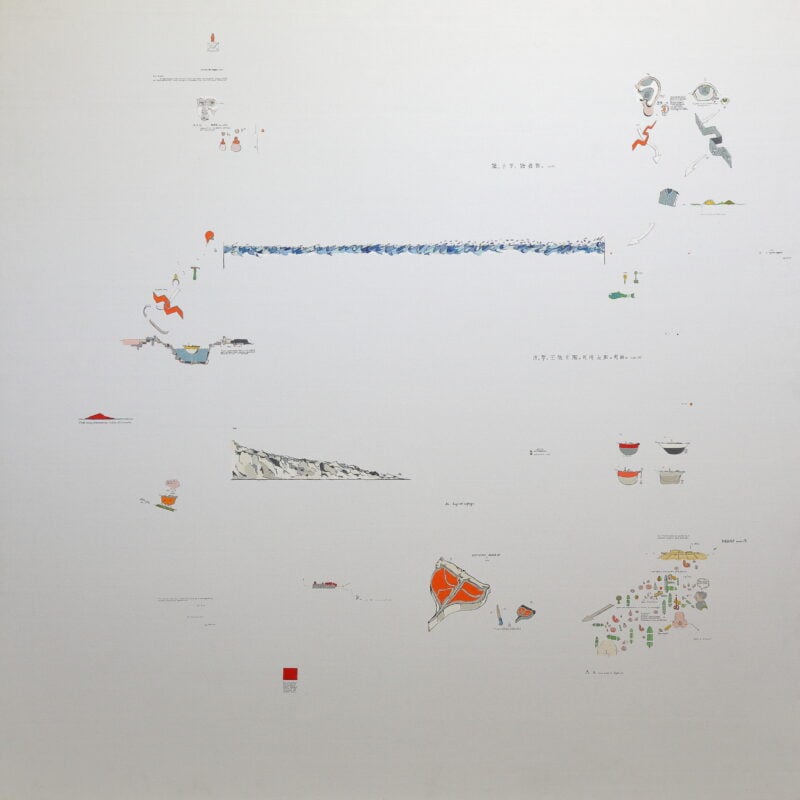
After training initially in economics and a brief period in industry, Baruchello began his life as artist in 1950s and moved quickly away from traditional pictorial models. From the start his research focused on “mental” painting, in which images, words, signs and micro-narratives coexist in complex spaces, often organized as maps or fields of graphic intensity. His works invite us to get lost in the details, transforming the act of viewing into an experience of exploration and thought.
In the 1960s Baruchello entered into dialogues with the main international avant-garde movements all the while maintaining his autonomy. He draws near to conceptual research, to the influence of Fluxus and to linguistic experimentation, but refuses to be identified with any in one movement particular. He works with paint, collage, film, installation and writing, constantly questioning the boundaries between image and text, art and life, artistic production and critical reflection.
A central element of his practice is his focus on systems – economic, political, linguistic and symbolic. Baruchello observes the world as a network of unstable relationships, in which the job of art is not to bring order but to make complexity apparent. In this sense, his work often takes on an ironic and even analytical dimension, capable of dismantling the mechanisms of power, of communication and of knowledge.
In the 1970s, the artist further increased his activities, expanding into agricultural projects, archival work, theoretical texts and community initiatives. Art becomes for him an instrument of continuous thought, an open laboratory in which aesthetic production, everyday experience and philosophical reflection are intertwined with each other and freed from hierarchies.