
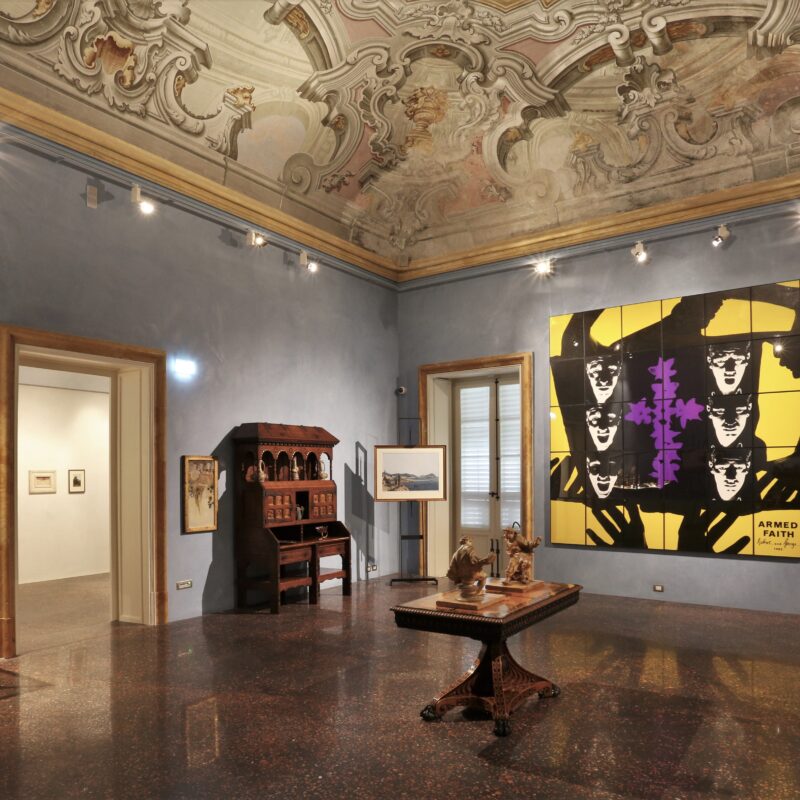
Room 13
For the colours of the State Rooms were chosen Marmorino, a technique that mixes colour into the plaster, before it is applied to the wall. Embedding the colour in this way gives a deep, richly chromatic surface that changes according to the light.
A Mirror “Box”
During the 1950s, this salon was divided into a corridor and some smaller rooms. To bring light into the corridor, a hole was punched through the vaulted ceiling up into the roof. This whole structure has now been removed, but it were still left with a disfiguring rectangular breach in the fresco. For this reason, a Mirror “Box” was built inside the hole. The intended effect is that, as you move about the room, the box is endlessly reflecting back mirrored images.

Edward Burne-Jones
Burne-Jones’s The Blessed Damozel (1857) is an unfinished work inspired by Dante Gabriel Rossetti’s poem of the same name. In this story of two lovers, the girl dies and goes to heaven and watches her lover continue his earthly life.
Francesco Zerilli
In this and the next salon, you will see two paintings of Palermo by Francesco Zerilli. Done at the beginning of the 19th century, the first is a view from Romagnolo with Monte Pellegrino in the background. In the next room is a more conventional frontal view of Palermo from the sea.
George Bullock
The table in the centre of the room is by George Bullock, a British architect-designer who at the beginning of the 19th century became so well known that his workshop was visited by Royalty. The two gesso sculptures on this table are by Alfred Stephens.
Tom Phillips
A 1980 work by Phillips takes up the entire wall. Taken from the opening phrase of Dante’s Inferno, the same words, «una selva oscura», are repeated and layered over each other.